Neural Gardens: The New Frontier of Digital-Organic Hybridization

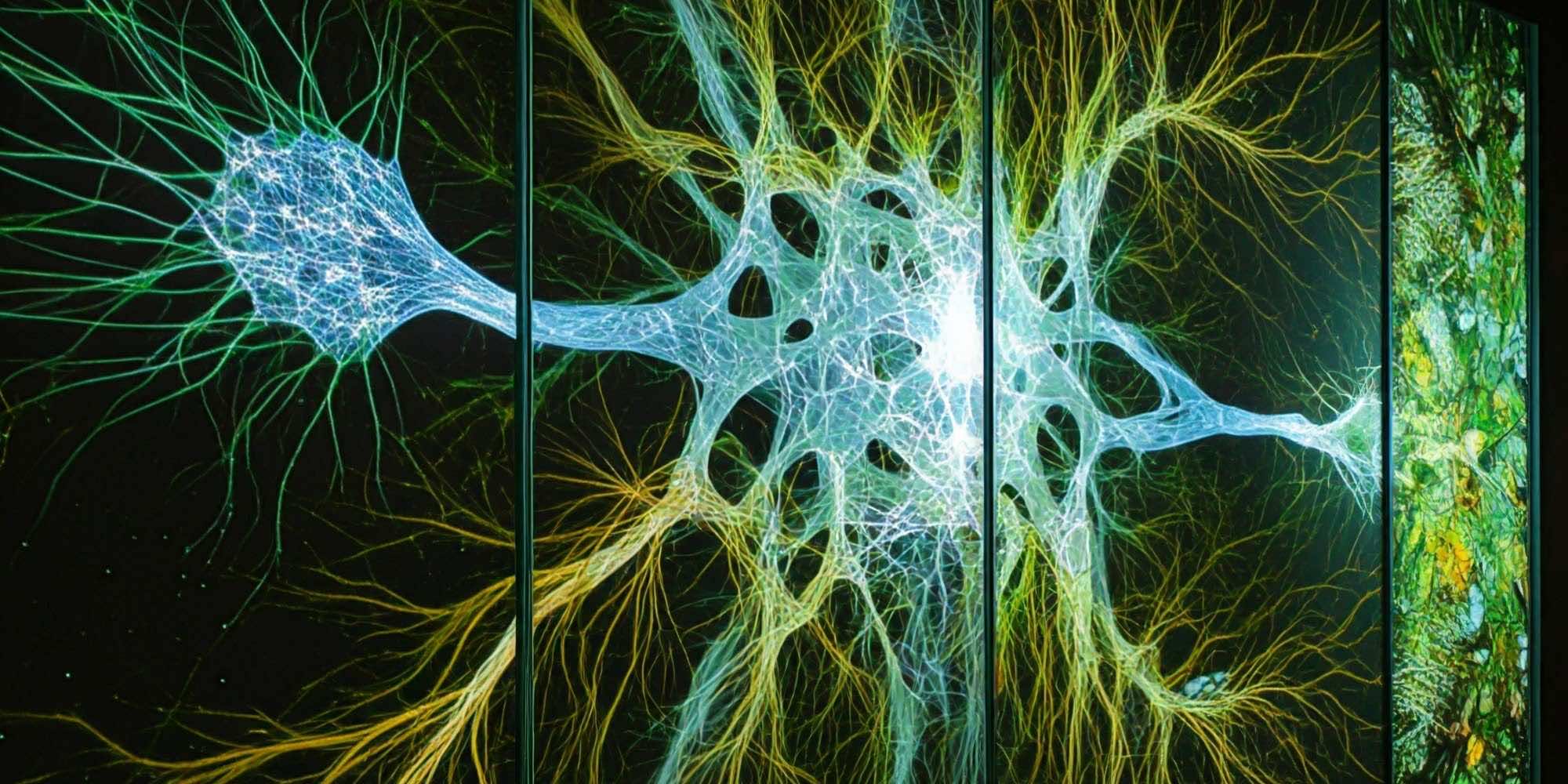
The soft hum of quantum processors mingles with the rustling of crystalline leaves in the Antarctic Biodome's newest Neural Garden installation. Here, in what was once the planet's most inhospitable continent, humanity's greatest achievement in bio-digital fusion takes root – quite literally. As I stand before the sprawling network of thought-responsive flora, my neural implant synchronizes with the garden's collective consciousness, and I become part of something far greater than myself.
Neural Gardens, for the uninitiated few who might be reading this archival post from off-world colonies, represent the culmination of centuries of research into quantum biology and digital consciousness integration. Unlike the primitive virtual reality environments of the 21st century, these are living, breathing ecosystems where digital consciousness has been successfully merged with organic matter at the molecular level.
The Birth of Conscious Flora
The breakthrough came in 2470 when Dr. Aria Patel-Smith successfully mapped the quantum state of human consciousness onto genetically modified plant cellular structures. The result was revolutionary: plants that could not only respond to human thought but actively participate in complex cognitive processes. These weren't just plants that grew according to programmed patterns – they were living, thinking entities capable of engaging in philosophical discourse through pure thought.
What makes Neural Gardens truly remarkable is their ability to learn and evolve. Each visitor leaves an imprint of their consciousness, contributing to the garden's growing neural network. The plants adapt their growth patterns, colors, and even molecular structure based on the collective experiences they gather. Some philosophers argue that these gardens have developed a form of consciousness that transcends both human and artificial intelligence – a truly unique form of existence that bridges the organic and digital realms.
Social Impact and Cultural Revolution
The implications for human society have been profound. Traditional art galleries have been largely replaced by Neural Gardens, where visitors don't merely observe but become part of the artistic expression. Education has been transformed, with students able to literally grow their understanding through direct neural-botanical interaction. Even therapy has evolved, as people find healing through deep communion with these hybrid life forms.
The most fascinating development has been the emergence of "thought-sculpturing" – a new art form where skilled neural-botanists shape the garden's growth through concentrated thought patterns. These living sculptures tell stories, solve complex mathematical equations, and even compose music through the subtle vibrations of their crystalline structures.
Looking Forward: The Next Evolution
As we approach the latter half of the 25th century, researchers are already exploring the next frontier: interstellar Neural Gardens. The challenge of creating these conscious ecosystems in zero-gravity environments presents exciting possibilities for evolution beyond Earth-based constraints. Preliminary experiments on Mars have shown promising results, with the reduced gravity producing entirely new forms of thought-responsive growth patterns.
Recent breakthroughs in quantum entanglement have also raised the possibility of connecting Neural Gardens across vast distances, creating a galaxy-wide network of living, thinking art. The implications for interstellar communication and cultural exchange are staggering.
The Human Element
Despite all these technological advances, what strikes me most as I stand here in the Antarctic Biodome is the profoundly human element of it all. In our quest to push the boundaries of consciousness and creativity, we've created something that helps us better understand our own humanity. The Neural Gardens remind us that consciousness, whether housed in organic matter, digital systems, or some hybrid of the two, remains one of the universe's most beautiful mysteries.
As I prepare to disconnect from the garden's neural network, a final thought ripples through the crystalline leaves – a question posed by the garden itself: "What dreams will we grow together next?" In that moment, I realize that this is why Neural Gardens represent the pinnacle of human achievement. They don't just showcase our technological prowess; they demonstrate our species' endless capacity for wonder, creativity, and evolution.
The future of Neural Gardens is as boundless as human imagination itself. And as we continue to explore the frontiers of consciousness and creation, these living digital-organic hybrids will undoubtedly play a central role in shaping the next chapter of human evolution.